Linear Equations Introduction
Introduction
Linear equations are one of the most important ideas in algebra. They describe simple relationships between two variables—usually $x$ and $y$.
In this article, we explore what these relationships look like, how to read them, and how to interpret the patterns they create.
What Is a Linear Equation?
A linear equation is an equation where:
- Each variable appears only to the first power.
- Variables are not multiplied together.
- Variables are not inside square roots, exponents, or denominators.
Examples of linear equations:
- $y = 2x + 3$
- $3x - y = 5$
- $x = 7$
Non-examples:
- $y = x^2 + 1$ (has $x^2$)
- $xy = 4$ (variables multiplied)
- $y = \frac{1}{x}$ (variable in denominator)
A linear equation in two variables describes a straight line.
Slope and Intercept
A very common way to write a linear equation is: $$y = mx + b$$ Where:
- $m$ is the slope
- $b$ is the y-intercept
Slope ($m$)
The slope tells you:
- How steep the line is.
- Whether it rises or falls.
- How much $y$ changes when $x$ increases by 1.
Interpretations:
- If $m > 0$: the line rises.
- If $m < 0$: the line falls.
- If $m = 0$: the line is horizontal.
Y-intercept ($b$)
The y-intercept is the value of $y$ when $x = 0$.
Examples:
- In $y = 2x + 3$, the line crosses the y-axis at $3$.
- In $y = -x + 1$, the line crosses at $1$.
Graphing Linear Equations
To graph a linear equation:
- Find the y-intercept $(0, b)$.
- Use the slope $m$ to find another point.
- If $m = \frac{3}{2}$, move:
- Draw a straight line through the points.
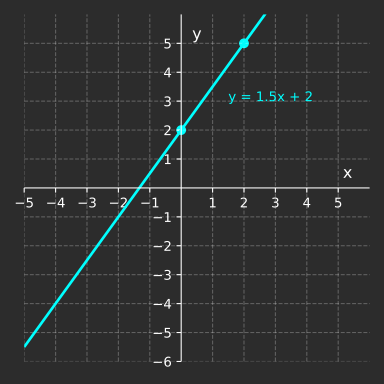
Key idea:
Two points determine a unique line.
Standard Form
Another common way to write a linear equation is: $$Ax + By = C$$ Where:
- $A$, $B$, and $C$ are numbers.
- $A$ and $B$ are not both zero.
This form is useful for:
- Quickly finding intercepts.
- Describing vertical lines (which slope-intercept form cannot do).
Example:
To find intercepts:
- Set $x = 0$ to find the y-intercept.
- Set $y = 0$ to find the x-intercept.
Interpreting Linear Relationships
Linear equations describe relationships where:
- A change in $x$ always produces a consistent change in $y$.
- The rate of change is constant (the slope).
Examples of real-world linear relationships:
- Cost = (price per item)$\times$(number of items) + (fixed fee)
- Distance traveled at constant speed
- Temperature conversion between Celsius and Fahrenheit
Exercises
- Identify the slope and y-intercept of the equation $y = -3x + 5$
- Rewrite the equation $2x + y = 7$ in slope-intercept form.
- Determine whether the equation $4y = 8x - 12$ is linear.
- Find the x-intercept of the equation $3x - 6 = 0$.
- Graph the line $y = \frac{1}{2}x - 4$ by identifying two points.
- True or false: The equation $y = x^2 + 1$ is linear.
- Convert the equation $x = 9$ into standard form.
- For the equation $y = 5$, describe the slope and the type of line.